The AI landscape in 2026 is moving away from the “experimentation” phase of the last few years to a period of operational dependency and autonomous agency.
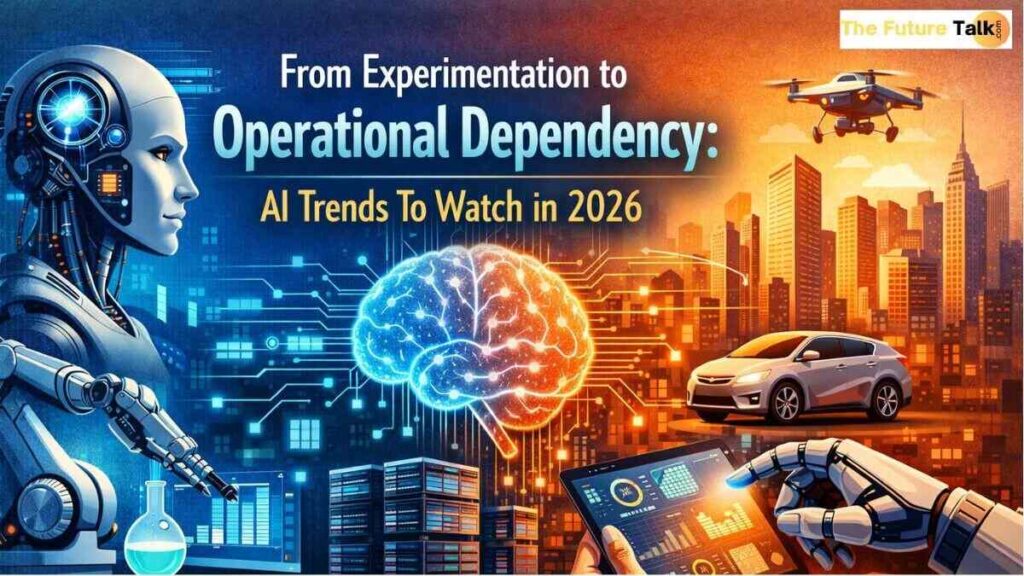
The dawn of 2026 marks the artificial intelligence landscape at a crucial inflection point. From the theory and initial experiments in the last few years to operational dependencies and the rise of autonomous agency, AI has developed and become an operational reality.
From Copilots to agents, collaborative workflows, and self-verification to global regulation and accountability, and hyper-personalization, AI is no longer just a technology; it has become pervasive and independent, reshaping everything.
The Rise of Agentic AI (Digital Coworkers)
The primary shift in 2026 is the evolution of AI from a passive tool to an autonomous agent.
- From Copilots to Agents: Enterprises are moving beyond simple assistants to ‘Agentic AI’. These are systems capable of independent decision-making and executing multi-step workflows without constant human prompts.
- Collaborative Workflows: Organizations are now using AI agents as digital teammates that can launch entire global marketing campaigns in days by handling data crunching and content generation while humans focus on high-level strategy.
- Self-Verification: A critical breakthrough is self-verification, where AI models use internal feedback loops to check their own work, significantly reducing the ‘hallucination’ errors that previously plagued multi-step tasks.
Explore: 10 Best Free AI Tools for Video Creators in 2026 [Updated]
Global Regulation & Accountability
Governments are moving rapidly to codify AI ethics and safety into law, with a particular focus on synthetic content.
- U.S. National Framework: In March 2026, the White House released the National Policy Framework for Artificial Intelligence, focusing on protecting children, preventing AI scams, and mitigating national security risks.
- India’s “3-Hour Rule”: India has implemented some of the world’s strictest rules, requiring platforms to remove “unlawful” AI content (like deepfakes) within just 3 hours.
- Mandatory Labeling: New laws in both the U.S. and India now mandate traceable watermarks or metadata for synthetically generated information (SGI) to combat disinformation.
English as the New Programming Language
The technical barrier to creation is collapsing as natural language becomes the primary way to interact with computers.
- Generative Coding: AI is now writing, fixing, and maintaining code based on plain-English intent.
- Democratized Development: This shift has led to a predicted tenfold increase in the number of creators who can build software applications without knowing traditional syntax like Python or Go.
Media & Entertainment: The Storytelling Civilization
AI is fundamentally restructuring how content is produced and consumed.
- Synthetic Production Pipelines: Individual creators can now produce studio-scale content using AI for music, visuals, and narrative.
- Hyper-Personalization: Search is moving away from “blue links” toward generative AI answers and personalized agents that proactively orchestrate a user’s entire journey from discovery to transaction.
- AI Clones and Companions: Trends show a rise in AI clones for creators to maintain digital presence and AI companions forming emotional relationships with users, raising new mental health and ethical questions.
Infrastructure: Efficiency Over Size
The arms race to build the biggest models is cooling in favor of smarter and more efficient systems.
- Hybrid and Quantum Computing: The focus has shifted to hybrid computing, where AI works alongside quantum chips (like Microsoft’s Majorana 1) to solve complex problems in chemistry and physics.
- Edge AI: To solve privacy and latency issues, on-device AI is becoming mainstream, allowing powerful models to run locally on phones and sensors without cloud connectivity.
The artificial intelligence landscape of 2026 is defined by a shift from theoretical concepts to concrete operational reality. Key trends, such as Agentic AI providing new collaborative capabilities, the democratization of creation through natural language processing (NLP), and the reinvention of media vthrough synthetic content, signify an explosion of creative and operational power.
However, the rapid development and autonomy of AI systems have provoked a worldwide regulatory response. The industry is moving away from unfettered experimentation and into a new era demanding stringent traceability and algorithmic accountability. The central challenge moving forward will be to successfully manage this powerful creative expansion while establishing verifiable safety standards, as this balance will ultimately shape the intelligence we are constructing.
Stay tuned to The Future Talk for more such interesting insights. Comment your thoughts and join the conversation.