The impact of AI on the job market is a transformative shift that mirrors previous industrial revolutions but at a much higher velocity.
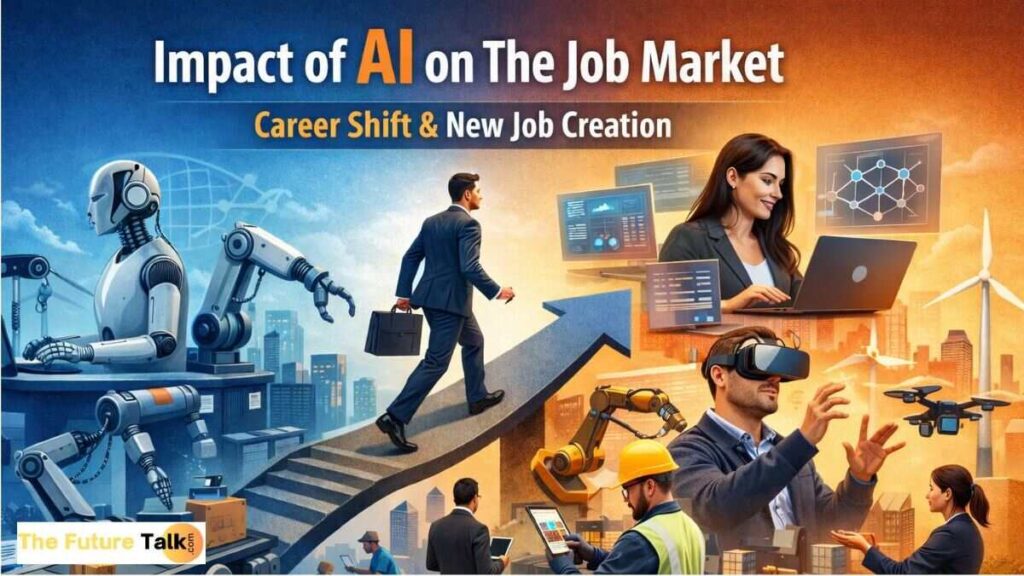
Artificial Intelligence (AI) is not a future concept for the global economy; it is already integrated into a lived reality. AI is rapidly and transformatively impacting the job market, a change far swifter than past industrial revolutions. This shift operates as a “dual force,” simultaneously automating routine jobs and generating entirely new professional fields.
A Shift from Routine to Cognitive Automation
Traditionally, automation focused on repetitive physical labor. In contrast, modern AI is increasingly adept at handling cognitive tasks.
- Vulnerable Sectors: Significant shifts are occurring in roles such as data entry, basic paralegal research, and routine administrative tasks. In the legal sector, for example, maintaining human oversight is a priority, as illustrated by some High Courts already restricting judges from using AI tools for legal research and judgment writing.
- The Gender Gap: A growing worry exists that the integration of AI into workplace environments could exacerbate the gender gap, particularly if underlying biases in algorithms used for hiring and promotion are not resolved.
Also Read: The AI Trade-Off in Oracle, Cutting Thousands of Jobs in Latest Layoff Round
New Career Frontiers
AI, while displacing some existing roles, is a significant driver of job creation. This is evident in the emergence of “Physical AI” and entirely new technical disciplines.
- AI Orchestrators & Prompt Engineers: Individuals who specialize in directing AI output.
- Physical AI Specialists: Professionals who are required as AI transitions from a purely digital realm into the physical world, fundamentally changing sectors such as manufacturing and logistics. These specialists are required for managing and maintaining intelligent robotics.
- Safety and Policy Officers: The increasing advocacy for new safety nets, such as that from companies like OpenAI, underscores a rising demand for policy officers and experts. These professionals are responsible for navigating the ethical and societal shifts characteristic of the burgeoning “AI Era.”
Must Read: Is Prompt Engineering The Next Solution For Your Successful Business Projects?
Productivity vs. Outsourcing the Brain
The continuous debate revolves around whether AI serves to augment human effort or, conversely, encourages a reliance on technology for cognitive tasks.
- Augmentation: For many, AI often serves as a “co-pilot”, taking over the mundane or drudge work and freeing up humans to focus on high-level strategy and creative tasks.
- The Risk: AI has the potential to elevate the output of less-experienced employees to a level previously associated with years of professional expertise. However, this advancement carries the risk of diminishing the value placed on foundational, entry-level skills.
Narrow AI vs. AGI
The job market’s future hinges on the evolution of Artificial General Intelligence (AGI), as the current effects are primarily driven by Narrow AI.
| Feature | Narrow AI (Current) | AGI (Theoretical) |
| Scope | Excels at specific tasks (e.g., coding, translation). | Matches human capability across almost all cognitive tasks. |
| Market Impact | Enhances productivity in specific sectors. | Could fundamentally redefine the necessity of human labor. |
| Human Role | Essential for oversight and direction. | Potential for total task autonomy. |
Explore Top 5 Alternative Careers For Data Science
The impact of AI on the job market is more intricate than a simple human-versus-machine conflict; it fundamentally redefines what constitutes “work.” Although industry leaders like OpenAI advocate safety nets and supporting infrastructure for this transformative period, people must prioritize adaptability to ensure their success.
Stay tuned to The Future Talk for latest updates. Comment your thoughts and join the conversation.